
How to Read Drill Results: A Practical Guide to What the Numbers Actually Mean
Six things to look for in every drill results news release — with real examples from a Nevada gold project

The Gold Grid — Teaching Series | March 2026 | Gilbert Analytics
Most investors read a drill results news release and focus on grade. The headline says “5.8 g/t gold over 19 meters” and they feel something — excitement, skepticism, confusion — but they don’t know what to do with it.
This guide teaches you how to read an assay table the way an analyst does. Not to make you a geologist, but to give you six specific skills that turn a wall of numbers into information you can use.
Every example below uses real data from Getchell Gold Corp.’s (CSE: GTCH) December 2, 2025 news release — a publicly available filing on SEDAR+ covering drill hole FCG25-36 at their Fondaway Canyon gold project in Nevada. I hold no shares in Getchell and have no advisory relationship with the company. It was selected here because this particular NR illustrates every concept in this guide almost perfectly.
1. The Assay Table: What Each Column Means
Here is the actual assay table from Getchell’s December 2025 news release:
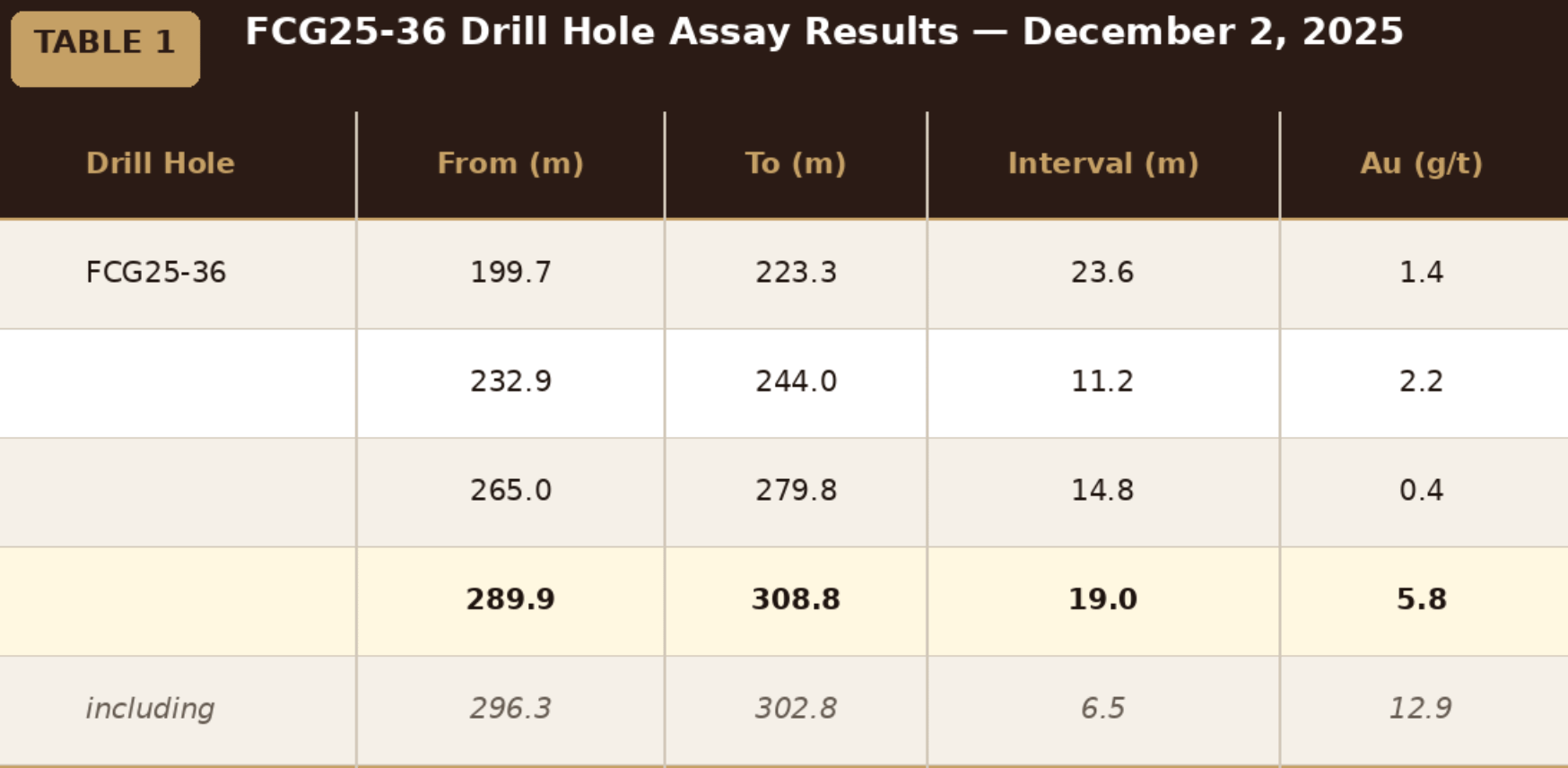
Source: Getchell Gold Corp. news release, December 2, 2025, publicly available at sedarplus.ca and getchellgold.com. All intervals reported as downhole drill lengths. No top cut applied.
Five columns. Each one tells you something specific.
From / To: Where in the drill hole mineralization starts and stops, measured in meters from the collar (top of the hole). The deepest interval in FCG25-36 begins at 289.9m and continues to 308.8m. That means the drill traveled nearly 300 meters into the earth before hitting this high-grade zone — an important detail for understanding deposit geometry.
Interval: The sampled length of the mineralized zone. Interval = To minus From. For the main high-grade intercept: 308.8 − 289.9 = 19.0m. This is the downhole length — not yet the true width of the mineralized zone. More on that distinction in section 4.
Au (g/t): The composite grade — grams of gold per tonne of rock, averaged across the entire interval. When the NR reports “19.0m @ 5.8 g/t,” that 5.8 g/t is already a length-weighted average of approximately 12 individual 1.5m core samples analyzed by the laboratory. Each sample was fire assayed individually; the NR shows you the weighted average result.
One observation on column order: Companies lay out their assay tables differently. Some put grade first, some put From/To first. Some add azimuth and dip. The columns above are the minimum you need. If any of them are missing — especially From/To — ask why.
2. Main Intercepts vs. “Including” — The Double-Counting Trap
This is the single most misunderstood element in drill results.
Look at the bottom two rows of the FCG25-36 table:
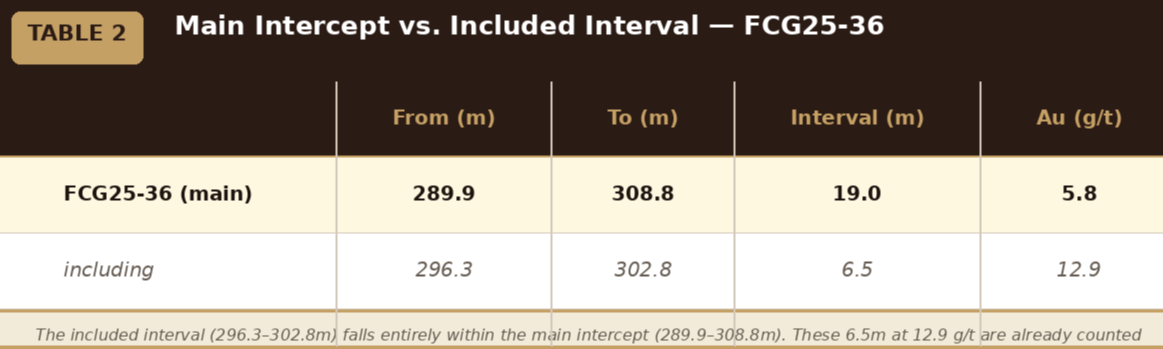
The main intercept (bold row) is 19.0m @ 5.8 g/t. That is the full mineralized interval — all 19 meters from 289.9m to 308.8m.
The “including” interval is a higher-grade zone nested inside the main intercept. Look at the From/To values: 296.3 to 302.8 falls entirely within 289.9 to 308.8. Those 6.5 meters at 12.9 g/t are already counted inside the 19.0m @ 5.8 g/t composite average.
The mistake: Adding the main intercept and the included interval together. If you add 19.0m + 6.5m, you get 25.5m — but there are only 19.0 meters of mineralized rock. The included interval is not additional gold; it’s the same gold, described at higher resolution.
Why companies report both: The included intervals tell you where the high-grade shoots are within the broader zone. In this case, 6.5 meters of the 19-meter interval runs at 12.9 g/t — more than twice the composite average. That’s valuable information for mine planning: it tells a geologist that the deposit has a high-grade core with lower-grade material around it, rather than uniform mineralization throughout.
The quick test: If the “including” interval’s From/To range falls inside the main intercept’s From/To range, it’s already counted. Always check the depth numbers. The included interval always nests within the main.
3. Grade × Width: The Number That Actually Matters
Here’s an uncomfortable truth: grade alone tells you almost nothing.
The FCG25-36 headline — “5.8 g/t over 19.0m” — is genuinely impressive. But Getchell reported another drill hole in their November 10, 2025 release (FCG25-33, same project, same program) that received less attention:
FCG25-33: 1.4 g/t Au over 122.3m
Which hole contains more gold?
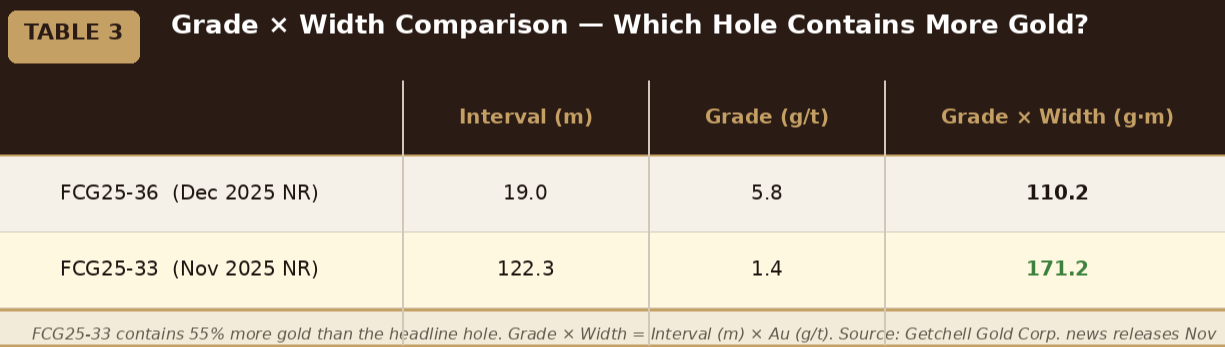
FCG25-36 got the bigger headline. FCG25-33 contains 55% more gold.
Grade × Width — also called the “metal factor” or “gram-meters” — multiplies grade and thickness into a single number that represents how much gold is in the ground at that location. It is the most analytically useful number in any drill result, and most news releases do not calculate it for you. You have to do it yourself.
Thresholds (practitioner benchmarks for gold, bulk tonnage deposits):
Below 10 g·m: Narrow and/or low grade. Speculative.
10–50 g·m: Potentially economic depending on mining method and deposit geometry.
50–150 g·m: Significant. Worth detailed analysis.
Above 150 g·m: Exceptional. These intercepts define deposits.
Note: These thresholds are not formally codified in CIM or SME standards — they reflect widely used practitioner benchmarks in gold exploration due diligence. Apply them as a first filter, not a hard rule.
Running the full FCG25-36 table:
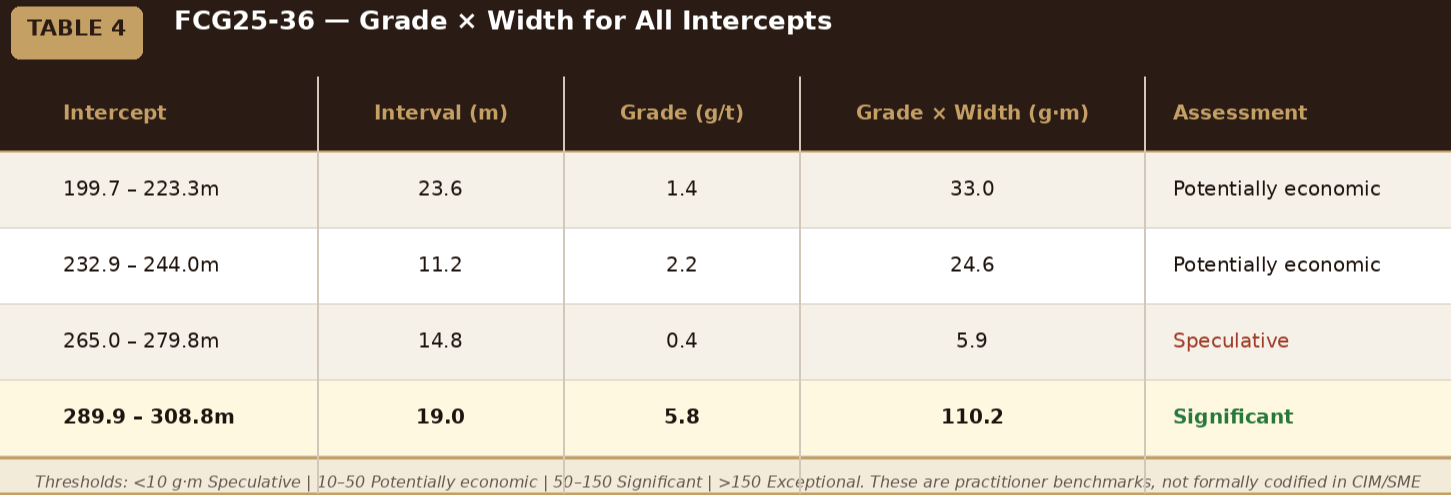
The headline intercept (5.8 g/t over 19.0m) justifiably leads the release. But notice the 0.4 g/t over 14.8m interval — barely 6 g·m. That result would not move a resource estimate. Reporting all intervals is standard practice and reflects good disclosure. The grade × width calculation is your tool as a reader to immediately distinguish the signal from the noise — without it, all four intervals can look equivalent on a quick scan.
4. True Width vs. Downhole Length — The Footnote Everyone Skips
At the bottom of Getchell’s assay table, there is a standard disclosure:
“All intervals are reported as downhole drill lengths and additional work is required to determine the true widths.”
This sentence appears in almost every junior mining NR. Most readers skim past it. It contains one of the most important methodological caveats in exploration geology.
Here is what it means:
A drill hole enters the ground at an angle — typically between 45° and 80° from horizontal, depending on the target geometry. The mineralized zone itself has its own orientation: it could be vertical, horizontal, or dipping at any angle. The interval measured along the drill hole (downhole length) is only equal to the true width of the mineralized zone if the hole intersects the zone perfectly perpendicular.
That almost never happens.
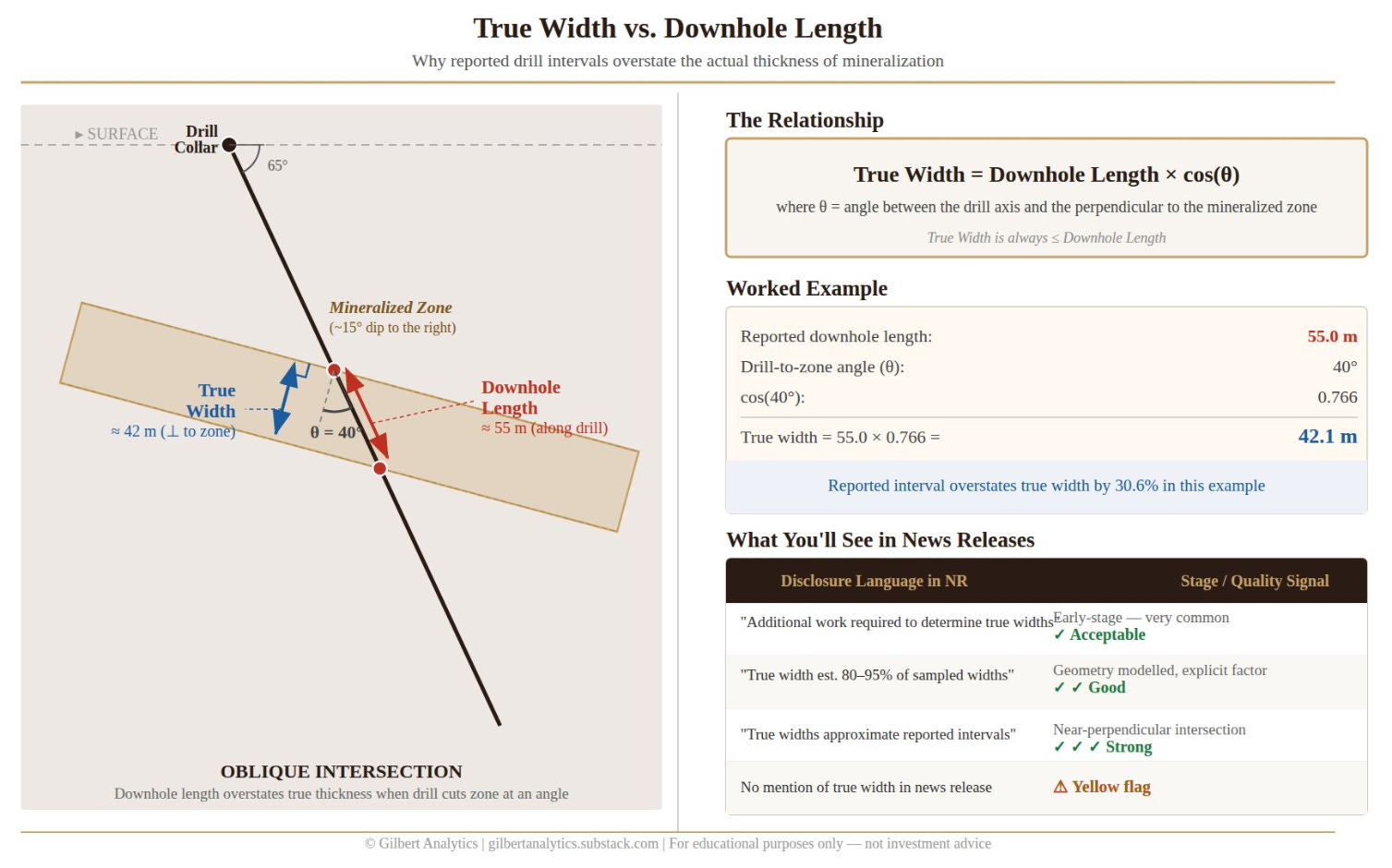
The geometry: When a drill hole intersects a mineralized zone at an oblique angle, the measured interval overstates the actual thickness of mineralization. The true width is always equal to or less than the downhole length. The correction factor depends on the angle between the drill and the zone.
What to look for in disclosure:
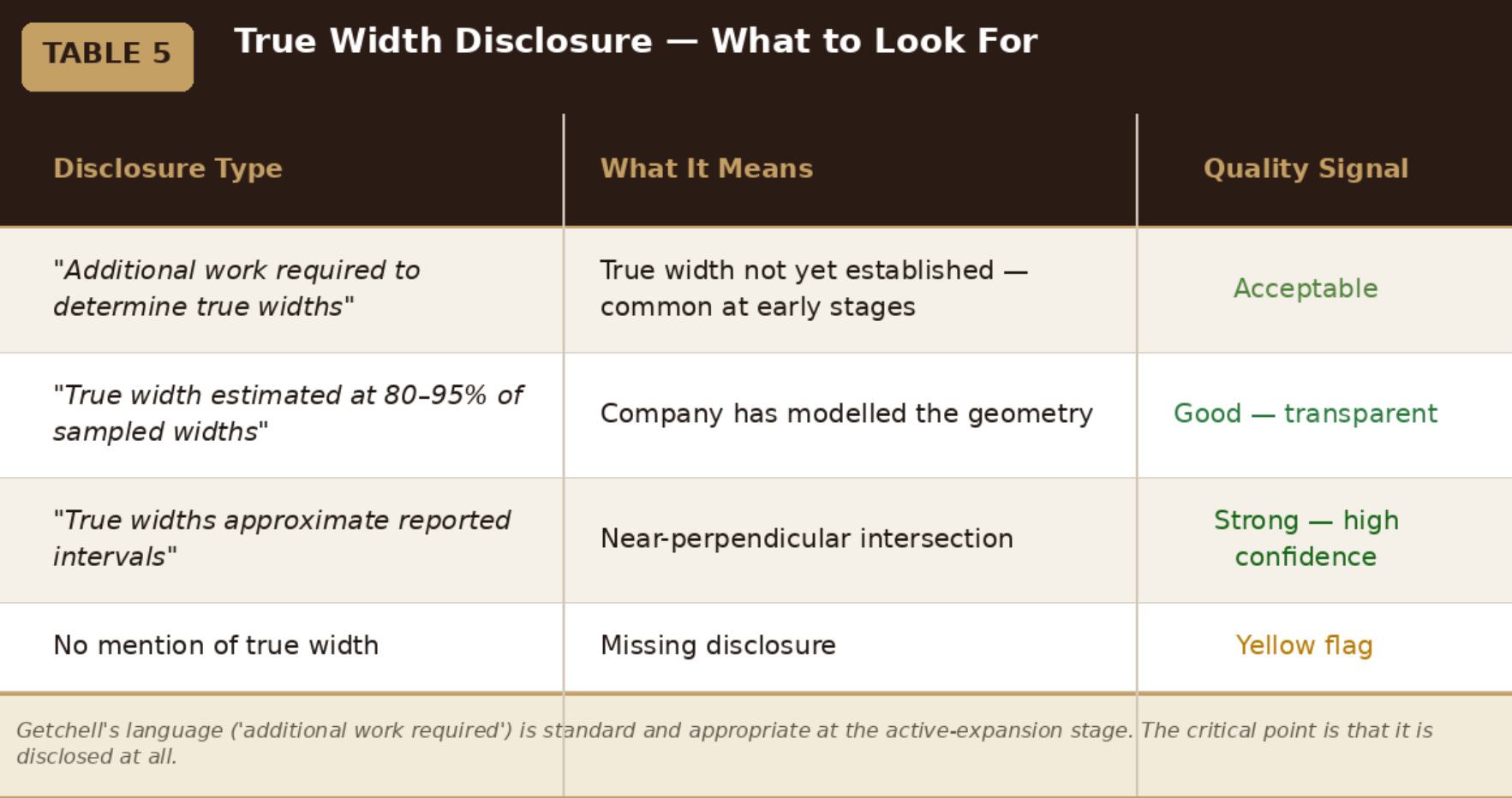
Disclosure TypeWhat It MeansQuality Signal”Additional work required to determine true widths”True width not yet established — common at early stagesAcceptable; standard language”True width estimated at 80–95% of sampled widths”Company has modelled the geometryGood — transparent”True widths approximate reported intervals”Near-perpendicular intersectionStrong — high confidenceNo mention of true widthMissing disclosureYellow flag
Getchell’s language (”additional work required”) is entirely standard and appropriate for a company actively expanding a resource. The important point is that it is disclosed at all.
For context: at a more advanced stage project, after sufficient drilling to model the deposit geometry, companies provide explicit correction factors. A Nevada gold project with a well-understood dipping structure might state: “True width is estimated to be between 80 and 95 percent of sampled widths” — meaning the reported 19.0m interval would represent approximately 15–18m of actual mineralized thickness.
Why it matters for analysis: Resource estimates use true thickness, not downhole length. If you are calculating a rough in-house resource using drill data, apply a conservative true width correction — typically 80% in the absence of explicit guidance for an oblique drill intercept.
5. Grade Capping: Cut vs. Uncut Grades
The December 2025 Getchell NR includes a disclosure that most investors overlook entirely:
“No top cut applied.”
This tells you that every grade reported in Table 1 is the raw assay result — no individual sample was limited. Understanding when this is appropriate (and when it is a concern) is the final analytical skill in this guide.
What grade capping is: Gold deposits often contain occasional extremely high-grade samples. A single 1.5m core interval might return 250 g/t gold while the surrounding samples run at 2–8 g/t. That spike is often a statistical outlier — a small visible gold grain, a vein intersection, or a sampling artifact. If left in the calculation, it distorts the composite grade upward.
Grade capping (also called “cutting” or “top cutting”) limits the maximum grade of any individual sample to a statistically defensible threshold. The typical cap is determined by variography or probability plots during resource estimation.
When “no top cut” is appropriate: For bulk-tonnage, low-to-moderate grade deposits like Fondaway Canyon — where individual intercepts consistently run at 1–6 g/t — capping has minimal impact. No single 1.5m sample is likely to spike high enough to distort a composite average of this magnitude. Reporting without a top cut is reasonable and transparent in this context.
When “no top cut” is a concern: For high-grade vein systems, where individual sample grades can run to hundreds of g/t, uncapped grades can be seriously misleading. To illustrate the difference, consider two invented projects with very different grade profiles:
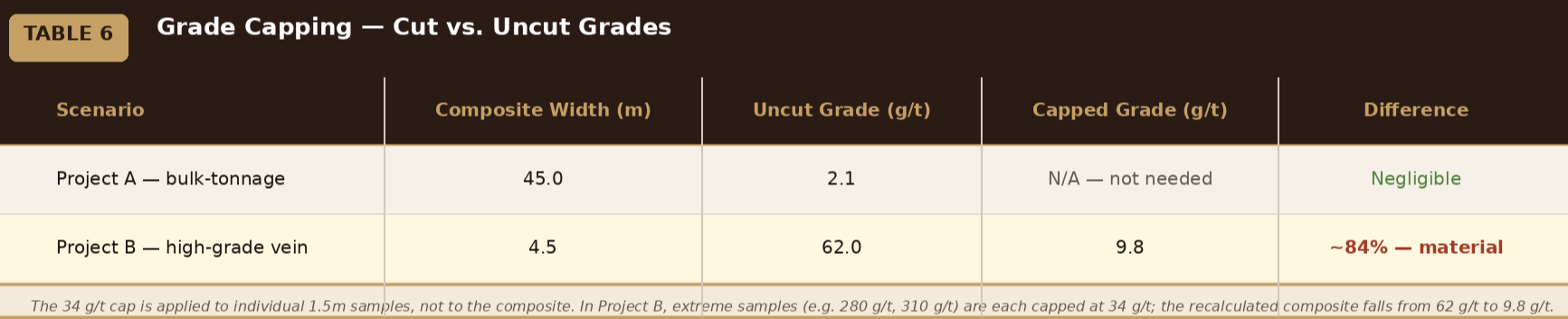
The cap of 34 g/t (equivalent to 1 troy ounce per ton) is applied to individual 1.5m samples, not to the composite. In Project B, a few extreme individual samples — say, 280 g/t and 310 g/t — are each capped at 34 g/t before the composite is calculated. The result is a composite grade of 9.8 g/t for the full interval, down from 62 g/t uncapped. The cap threshold is 34 g/t; the capped composite is 9.8 g/t. In Project A, no individual sample is high enough to distort the composite, so no cap is warranted.
In Project B, a handful of extreme samples inflate the composite grade by 84%. That changes a project’s economics entirely. For Fondaway Canyon running consistently at 1–6 g/t, this effect is negligible — which is why “no top cut applied” is an appropriate and honest disclosure here.
What to look for:
“No top cut applied” on results below ~10 g/t composite: Generally acceptable
“No top cut applied” on results above ~20 g/t composite: Requires scrutiny — ask what the grade distribution looks like
Both cut and uncut reported: Best practice — transparent about outliers regardless of deposit type
No mention of capping at all, high-grade results: Yellow flag
6. The Quick Checklist: Reading Any Drill Results NR
Next time a junior explorer drops drill results, run through this in order:
☐ Does the NR include an assay table with actual From/To/Width/Grade columns? If the release contains adjectives (”significant,” “robust,” “world-class”) but no assay table, it’s marketing, not data. This was Red Flag #1 from GG-003.
☐ Can you distinguish main intercepts from included intervals? Check the From/To values. Included intervals nest inside main intercepts. Only count main intercepts for total mineralized width.
☐ Calculate Grade × Width for each main intercept. Interval (m) × Grade (g/t) = gram-meters. Below 10 g·m is speculative. Above 50 g·m is significant. Above 150 g·m is exceptional. The NR will not calculate this for you.
☐ Does the NR address true width? Look for explicit language. “Additional work required” is acceptable at early stages. An explicit correction factor is better. Complete silence is a yellow flag.
☐ Does the NR address grade capping? “No top cut applied” is fine for bulk-tonnage, low-grade systems. For high-grade intercepts (above ~10 g/t composite), check whether the grade distribution is disclosed.
☐ How many holes are in this release, and how many in the total program? One spectacular hole is a discovery. One program of ten consistent holes is the beginning of a deposit. Getchell’s 2025 program totalled 10 holes across 3,346m of drilling — FCG25-36 is one of the final holes of the program, but it is evaluated in the context of the full campaign. One hole proves there is gold at one point underground. Ten consistently mineralized holes begin to define geometry, continuity, and scale.
What This Guide Is — and What It Is Not
This is a reading guide. It teaches you to extract information from public data that most investors walk past. It does not tell you which companies to buy, which drill results are “good enough,” or how to value a project based on drill data alone.
Drill results are one input in a much larger analysis. The next steps — resource estimation, valuation, comparable transaction analysis — are covered in other issues of The Gold Grid.
But those next steps are worthless if you can’t read the raw data first. Now you can.
What part of reading drill results has confused you most? Leave a comment below — your questions help shape the next Teaching Short.
Previous issues of The Gold Grid: - GG-001: Mind the Gold Gap - GG-002: What Acquirers Actually Pay for Gold in the Ground - GG-003: Red Flags in Junior Mining: 10 Warning Signs That Protect Your Capital
For the Gold Gap Index and free analytical tools: Gilbert Analytics on Substack | LinkedIn
Sources: Getchell Gold Corp. news releases dated December 2, 2025 and November 10, 2025, both publicly available at sedarplus.ca and getchellgold.com. Grade × Width (gram-meters) is a standard industry metric used in resource estimation and due diligence. True width methodology per CIM Best Practice Guidelines for Mineral Resource Estimation (2019). Grade capping methodology and threshold guidance per Glacken & Snowden (2001), “Mineral Resource Estimation,” in Edwards (ed.), Mineral Resource and Ore Reserve Estimation — The AusIMM Guide to Good Practice.
Disclosure: This article is for educational and informational purposes only and does not constitute investment advice. The author is not a licensed financial analyst, broker-dealer, or Qualified Person (QP) as defined by NI 43-101. The author holds no shares in Getchell Gold Corp. (CSE: GTCH) and has no advisory relationship with the company. GTCH is one of the companies screened through the Gold Grid Selection System; its inclusion here reflects its utility as a teaching example, not a recommendation to buy, sell, or hold the stock. Readers should conduct their own due diligence before making any investment decisions.
Really good primer. Has taken me decades to acquire most of this knowledge on my own. The only thing missing would be diamond core vs reverse circulation drilling.